
Advanced Research in Computational Sciences and Artificial Intelligence (ARCS∙ai) announced the launch of the ARPI Center in Yerevan on November 20, 2026. The shared robotics and Physical AI center has a stated goal of graduating 50 specialized engineers annually by combining faculty, students and equipment from three Armenian universities.
ARPI stands for Armenian Robotics & Physical Intelligence. Its focus is Physical AI, which the announcement describes as the convergence of robotics and artificial intelligence. The center’s national-lab model pools resources across the American University of Armenia (AUA), Yerevan State University (YSU) and the National Polytechnic University of Armenia instead of having each institution build separate robotics capacity.
The formal presentation at Digitec took place at Yerevan’s Meridian Exhibition Center with NVIDIA’s Rev Lebaredian, vice president of physical AI simulation, representatives of the participating universities and live robot demonstrations. Beyond the presentation, the center already has an undergraduate cohort and courses in progress.
Undergraduate Courses Already Underway
Thirty students are enrolled in the first semester of a three-semester Physical AI minor offered within AUA’s Engineering program and YSU’s Data Science program. Nine courses are being delivered across those two universities, spanning robot mechanics, control and estimation, reinforcement learning, digital twins, and the ethics and governance of Physical AI.
The course catalog shows how classroom topics connect to hardware. Its dynamical systems, control and estimation course combines modeling and controller design with experiments on single-degree-of-freedom mechanisms and multi-rotor aerial robots. The simulation, digital twins and differentiable physics course requires prior study in deep learning, robot mechanics, and control and estimation, placing advanced simulation work after those foundations.
A Physical AI master’s program is scheduled to launch at AUA in 2027. The catalog’s planned capstone has teams build a complete system through simulation, data collection, policy training, transfer from simulation to real hardware, deployment and evaluation. It also brings mechanical design, sensor suites and a safety envelope into that end-to-end project, extending the training pathway beyond the undergraduate minor.
Faculty Appointments and Robotics Infrastructure
Fourteen faculty members are engaged, including eight recruited from institutions in the United States and Europe, such as the University of Southern California, TU Delft and the Rutherford Appleton Laboratory. Astghik Hakobyan has become the first ARCS∙ai Fellow under a three-year joint appointment between AUA and ARCS∙ai.
AUA and ARCS∙ai have signed a memorandum of understanding governing their collaboration, while a similar YSU agreement remains in development. That distinction matters for a center built around shared staff and equipment: one university partnership is formalized, while another is still being negotiated.
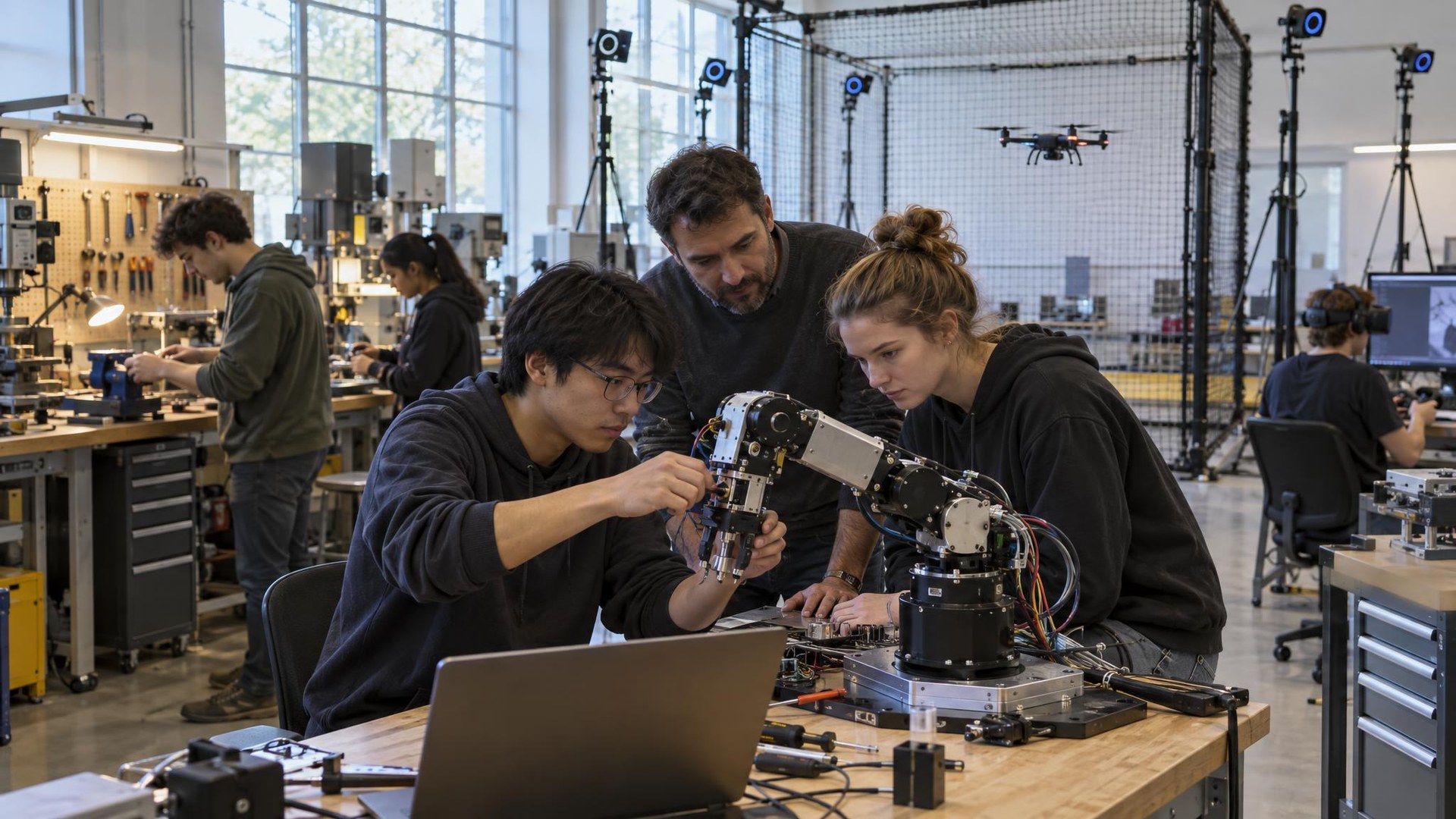
The center’s physical base is a new robotics laboratory representing a $500,000 investment. It contains robotic manipulator arms, ground robots, virtual-reality headsets, a machine shop and a large drone flight area with motion tracking. On-site NVIDIA GPUs will support AI training and robot simulation. Students and researchers also have access to the Firebird AI initiative’s GPU cluster, which ARCS∙ai describes as one of Europe’s five largest.
External Collaborations at Different Stages
ARCS∙ai is exploring collaborations with Agile Robots of Germany, FieldAI of the United States and KM-RoBoTa of Switzerland; those collaborations remain exploratory. Institutional discussions are also underway with the University of Michigan-Dearborn, Caltech, ETH Zurich and EPFL. The center separately continues its existing work with YerevaNN on applied AI and robotics.
ARPI is inviting faculty and postdoctoral researchers to participate through short visits, sabbaticals or longer-term appointments, adding another route to expand teaching and research capacity. The scheduled master’s program provides a concrete expansion point, while the unfinished YSU agreement and exploratory external talks leave parts of the shared model still to be secured.
